

中央大學團隊破解深層月震之謎 首次以電磁方法揭示月函非均質與部分融熔證據
NCU Team Unravels the Mystery of Deep Moonquakes: Electromagnetic Observations Provide First Evidence of Mantle Heterogeneity and Partial Melting in the Moon
An international research team led by Professor Ping-Yu Chang from the Department of Earth Sciences and the Center for Space and Science Technology at National Central University (NCU) has proposed a new explanation for the long-standing mystery of deep moonquakes (DMQs). Collaborating with scientists from the Earthquake Research Institute of the University of Tokyo and the University of California, Los Angeles (UCLA), the team analyzed magnetometer observations deployed on the lunar surface during the Apollo 12, 15, and 16 missions. Their work successfully established a model of the Moon’s deep electrical resistivity structure and offers new insight into the origin of deep moonquakes. The study has been published in the international journal Earth, Planets and Space.
The research applies a mature electromagnetic exploration technique widely used in Earth sciences—Geomagnetic Depth Sounding (GDS)—to analyze natural magnetic field disturbances experienced by the Moon when it passes through Earth’s magnetotail. As variations in the external magnetic field penetrate the lunar interior, their propagation characteristics are influenced by subsurface electrical conductivity structures. By analyzing these magnetic variations, researchers can invert for the resistivity distribution at different depths within the Moon, allowing them to infer its composition and thermal state.
Notably, part of the magnetic field data used in this study originated from original magnetic tapes recorded during the Apollo missions. After the missions ended, these tapes were stored in archives for decades and were nearly forgotten. In recent years, scientists rediscovered these more than forty-year-old datasets while reorganizing Apollo mission archives. Through modern digital restoration and reconstruction techniques, the historical lunar observations have been revived and made available for new scientific analysis.
Professor Chang noted that the research is also closely related to the Lunar Vector Magnetometer (LVM) mission currently being developed at NCU under commission from the Taiwan Space Agency (TASA). Deploying a new generation of electromagnetic instruments on the lunar surface would enable scientists to resolve the Moon’s deep interior structure and thermal evolution with greater precision. The study not only deepens our understanding of the Moon’s interior but also provides important scientific foundations for future in-situ electromagnetic exploration missions, highlighting NCU’s growing international influence in planetary geophysics and deep-interior exploration research.
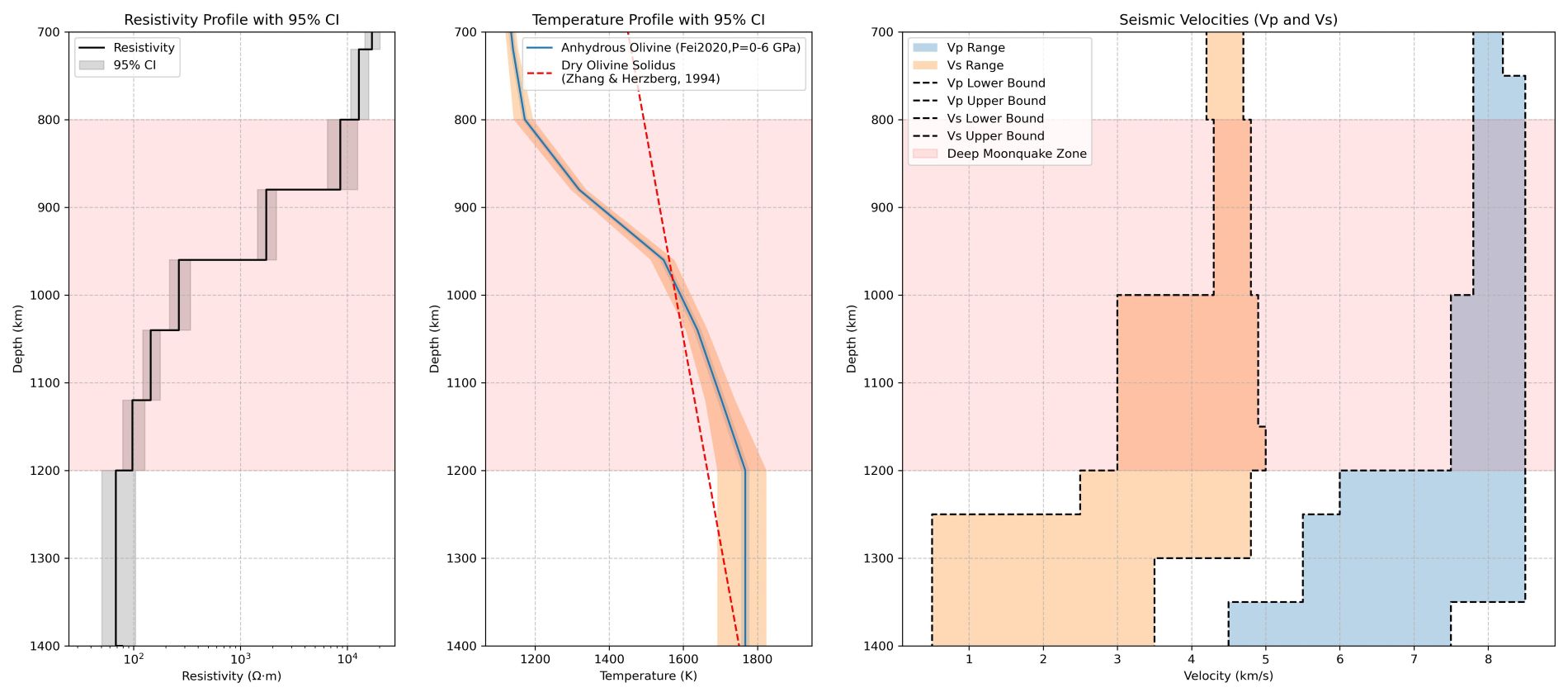
左:本研究推導之月球內部 700 km 至 1400 km 深度範圍的電阻率剖面。
中:根據 Fei 等人(2020)與 Ringwood(1976)之實驗所建立的溫度–電阻率關係,並結合本研究所得電阻率剖面所估算之溫度分布剖面。
右:來自過去月球探測任務所獲得的 P 波速度(Vp)與 S 波速度(Vs)剖面(改繪自 Matsumoto 等人(2015))。圖中同時標示了月球正面之深層月震區(Deep Moonquakes, DMQs)。張竝瑜教授提供
國立中央大學太空科學與科技研究中心與地球科學系張竝瑜教授帶領的國際研究團隊,與日本東京大學地震研究所及美國加州大學洛杉磯分校(UCLA)科學家合作,利用阿波羅 12、15、16 號任務於月球表面所佈設的磁力儀觀測資料,成功建立月球深部電阻率結構模型,並對長期未解的「深層月震」(Deep Moonquakes, DMQs)成因提出新的科學解釋。研究成果已獲國際期刊《Earth, Planets and Space》正式接受刊登。
本研究運用地球科學領域成熟的電磁探測技術——地磁深部探測(Geomagnetic Depth Sounding, GDS),分析月球位於地球磁尾期間所受到的天然磁場擾動。當外部磁場變化穿透月球內部時,其傳播特性會受到地下導電結構影響,因此可透過磁場變化反演月球內部不同深度的電阻率分布,進而推估其組成與熱狀態。
研究團隊分析三個阿波羅登陸地點的磁場資料,研究結果顯示,月球上部月函在約 300 公里深度內普遍呈現高電阻特性,顯示該區域整體較為乾燥、缺乏揮發物與熔融物質。然而在 300 至 500 公里深度之間,各觀測地點出現明顯差異,顯示月球內部存在顯著的橫向非均質結構。研究推測,此現象可能與月球早期岩漿海(Lunar Magma Ocean)冷卻演化過程中,富含鐵鈦礦物的物質向深部下沉,造成熱化學成分不均勻分布有關。
值得注意的是,本研究所使用的部分磁場觀測資料來自阿波羅任務時期所錄製的原始磁帶。這些資料在任務結束後長期被存放於倉庫中,幾乎被遺忘。近年來在科學家重新整理阿波羅資料檔案的過程中,這批距今已超過四十年的磁帶資料才被重新發現,並透過數位修復與重建技術得以重新分析,使得當年的月面觀測資料得以再次發揮科學價值。
本研究為首次透過電磁觀測資料,對深層月震的形成機制提出具有物理一致性的解釋,也顯示地球上發展成熟的電磁探測技術可成功應用於月球深部結構研究。隨著全球新一波探月計畫的推進,包括美國 NASA 的 Artemis 計畫與中國的嫦娥七號任務,都將在未來數年內重新建立月球表面長期觀測站,進一步探測月球內部結構。
張竝瑜教授表示,此研究成果同時也與台灣國家太空中心(TASA)委託中央大學研製的月面向量磁力儀(Lunar Vector Magnetometer, LVM)探測任務密切相關。未來若能在月球表面佈設新一代電磁觀測儀器,將有機會更精確地解析月球深部結構與熱演化歷史。這項研究不僅深化人類對月球內部結構的理解,也為未來月球原位電磁探測任務提供重要科學依據,展現國立中央大學在行星地球物理與深部探測研究領域的國際學術實力。
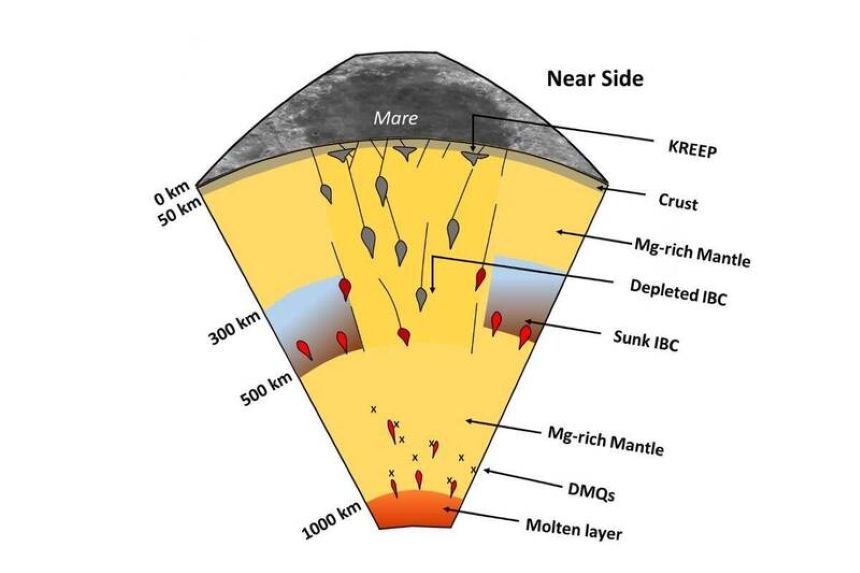
根據 Apollo 12、15 與 16 任務之地磁深部探測(Geomagnetic Depth Sounding, GDS)反演結果與熱結構估計所建立之月球正面(月球近側)地函結構概念模型。張竝瑜教授提供