

中央大學成功重現懸而未決逾60年的月球外部磁場增強現象
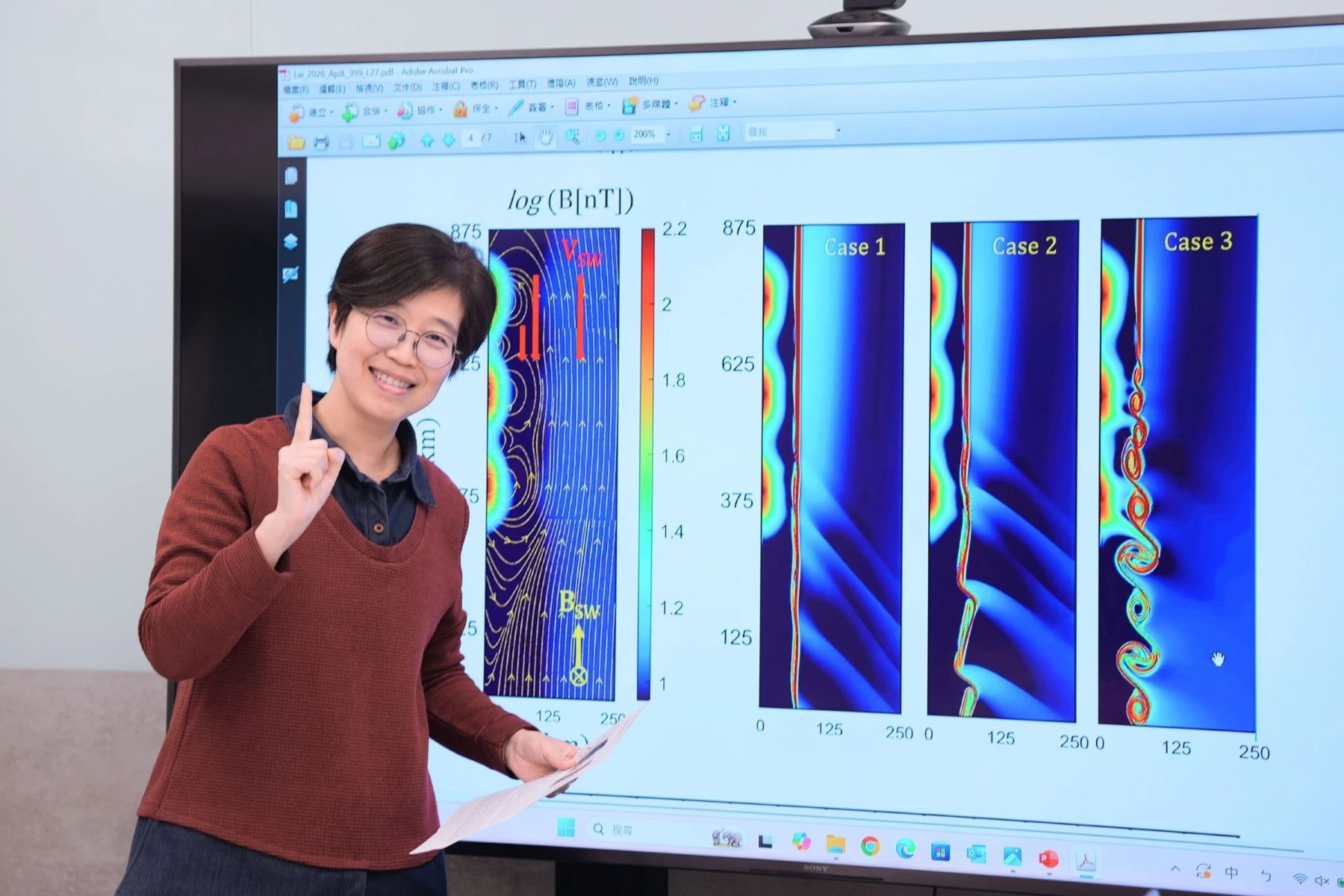
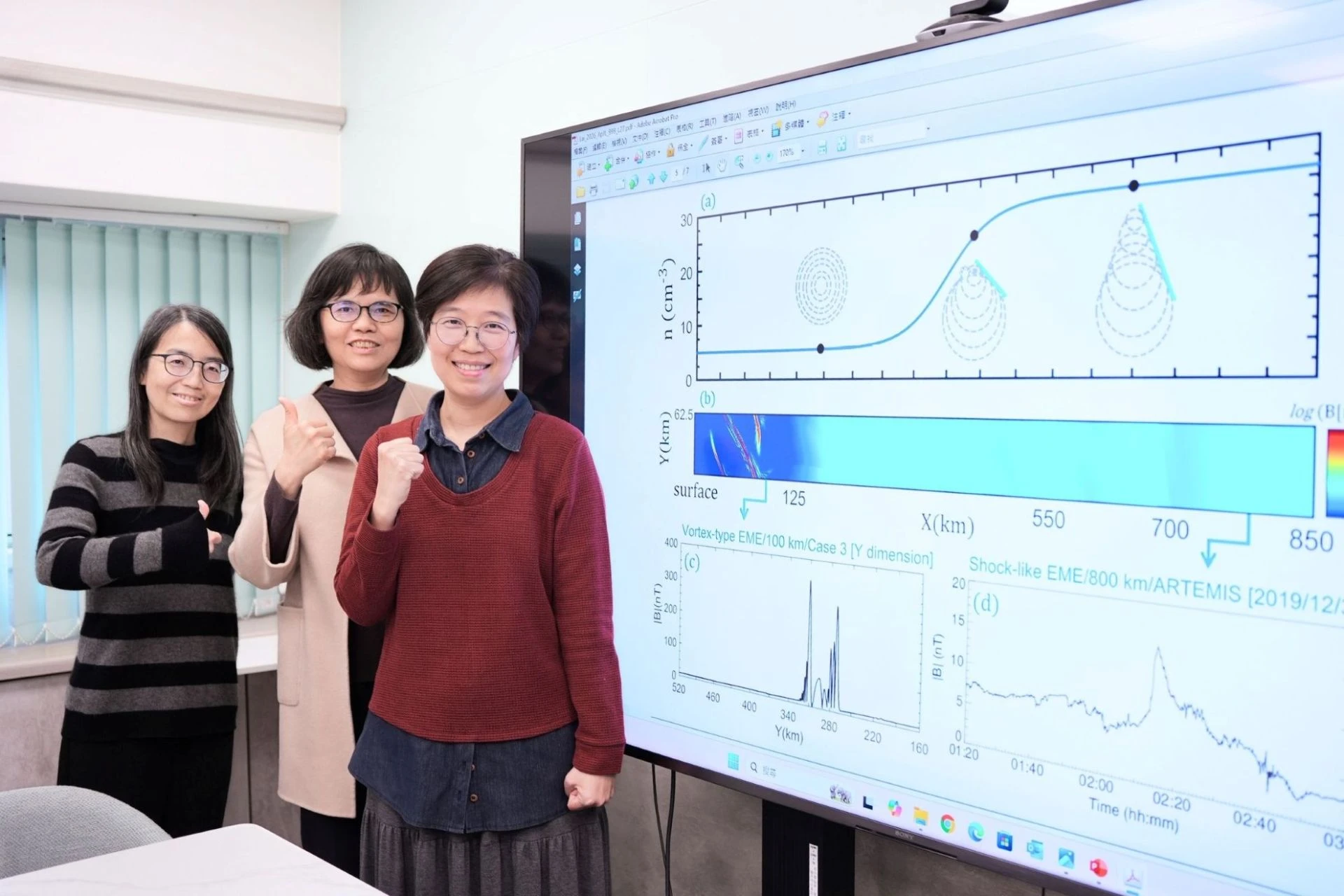
國立中央大學太空科學與科技研究中心助理研究員賴淑華博士近期以第一作者暨通訊作者身分,與淡江大學航空太空工程學系汪愷悌助理教授及中央大學太空科學與工程學系楊雅惠教授合作,在國際頂尖天文期刊The Astrophysical Journal Letters(ApJL)發表研究論文「Shock-like Magnetic Enhancements Generated by Kelvin–Helmholtz Instability above Weakly Magnetized Bodies」。研究針對自1960年代以來反覆被觀測到、卻始終缺乏完整解釋的「月球外部磁場增強」現象(Lunar External Magnetic Enhancements, LEMEs),提出全新的物理解釋機制,並結合數值模擬與觀測資料首度成功重現其空間結構與演化。
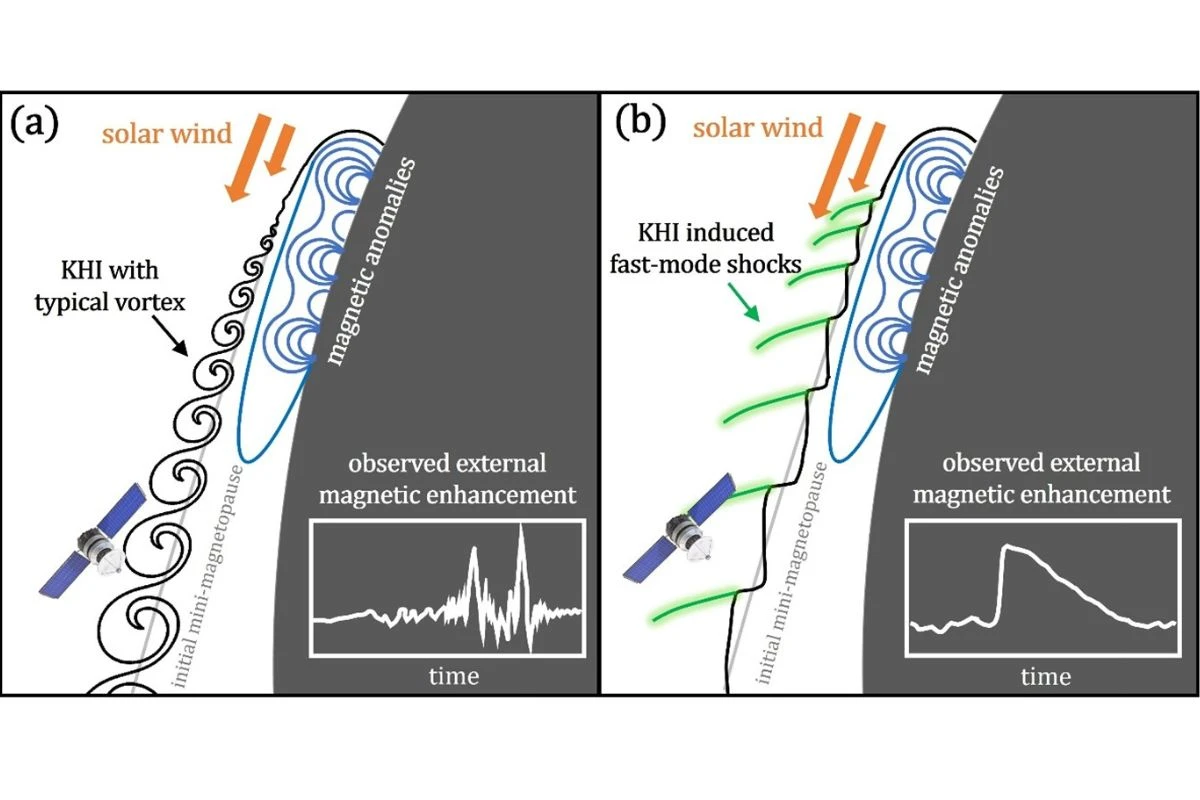
研究成果指出,一種長期被忽略的Kelvin–Helmholtz instability (K-H不穩定)非線性演化類型,能在月球強地殼磁場上空自然產生類似震波的局部磁場增強結構,完整對應過去逾半世紀的探測結果。早在1960年代之Explorer 35與1970年代之阿波羅任務期間,科學家便發現月球上空某些區域會出現突然而劇烈的磁場增強事件,磁場強度可較背景太陽風磁場高出數倍甚至一個數量級以上,並延伸至數百公里的高空。後續Lunar Prospector、Kaguya 與 ARTEMIS等繞月任務證實,這些「月球外部磁場增強」多與月球局部強地殼磁場相關,但既有的靜態磁場壓縮模型,難以同時解釋其陡峭波形、垂直延伸高度以及振幅範圍等多樣化特徵。
賴淑華博士長期從事電漿物理與數值模擬研究,對K-H不穩定相關的物理機制與現象已有多年深入耕耘,這是她首次將這套機制系統性應用到月球環境上,用以解釋弱磁場天體上空的局部磁場增強來源。能夠在頂尖期刊ApJL上證實這個長久以來被忽略的震波類型之K-H不穩定,並給了懸而未決逾半世紀的月球上空磁場增強現象一個合理生成機制,讓她對未來將這套理論模型延伸到其他天體充滿期待。月球雖然沒有像地球那樣的全球性磁層,局部強地殼磁場與太陽風之間的速度切,卻能孕育出相當複雜的邊界不穩定與震波結構,進一步改變我們對太陽風與弱磁場天體互動的傳統想像。
這套機制不侷限於月球,未來也可延伸應用於火星之局部強地殼磁場區以及其他弱磁化或局部磁化天體,作為理解其周圍局部磁層結構與能量傳輸的關鍵線索,更重要的是,在未來月球基地與深空探測任務規劃的長遠視角下,掌握這類局部強磁場與電漿環境的交互作用動力過程,也將有助於評估未來太空船與儀器在這些區域運作時可能面臨的太空環境風險,並優化科學酬載的佈局與觀測策略。這次發表於ApJL的成果,是中大「月球向量磁場儀」團隊參與臺灣國家太空中心(TASA)首個國家級月球探勘任務的重要科學成果之一。
共同作者汪愷悌助理教授強調,團隊在月球磁場、電磁波動與電離層結構三個面向上都已累積具份量的成果,將為未來臺灣在月球科學探索上建立關鍵基礎。「月球向量磁場儀」計畫主持人同時也參與這項研究的楊雅惠教授認為,有了這些科學成果基礎,在設計儀器量測策略與規劃儀器觀測模式時,可以更具體預期可能出現的信號。本研究感謝臺灣國家太空中心在酬載儀器研發與任務規劃上的支持,以及國立中央大學太空科學與科技研究中心提供的計算資源與研究環境,並獲國家科學及技術委員會相關專題計畫補助。
更多研究詳情可參考《天文物理期刊快訊》文章連結: https://doi.org/10.3847/2041-8213/ae4745
來源:中大新聞中文
Dr. Shu-Hua Lai, an Assistant Researcher at the Center for Astronautical Physics and Engineering (CAPE) at National Central University (NCU), has recently published a research paper in the leading international journal The Astrophysical Journal Letters (ApJL) as first and corresponding author. The study, titled “Shock-like Magnetic Enhancements Generated by Kelvin–Helmholtz Instability above Weakly Magnetized Bodies,” was conducted in collaboration with Assistant Professor Kaiti Wang from the Department of Aerospace Engineering at Tamkang University and Professor Ya-Hui Yang from the Department of Space Science and Engineering at NCU.
The research challenges the long-standing puzzle of Lunar External Magnetic Enhancements (LEMEs), which have been repeatedly observed since the 1960s yet remain unsatisfactorily explained. By combining numerical simulations with spacecraft observations, the team has, for the first time, proposed a new mechanism for LEMEs and successfully reproduced their spatial structure and amplitude.
The findings reveal that a long-overlooked nonlinear branch of the Kelvin–Helmholtz (K–H) instability can naturally generate shock-like localized magnetic enhancement structures above the lunar crustal magnetic fields, fully accounting for more than half a century of observations. As early as NASA’s Explorer 35 mission in the 1960s and the Apollo missions in the 1970s, scientists discovered pronounced magnetic field enhancements above certain regions of the lunar surface. The magnetic field strength in these areas can spike several times—or even more than an order of magnitude—above the ambient solar wind magnetic field, extending to altitudes of hundreds of kilometers. Subsequent lunar missions, including Lunar Prospector, Kaguya, and ARTEMIS, confirmed that these external magnetic enhancements are associated with the lunar localized crustal magnetic fields. However, existing static magnetic field compression models have struggled to reproduce and explain their steep waveforms, vertical extent, and broad amplitude range.
This newly identified mechanism is not confined to the Moon. It can also be applied to crustal magnetic field regions on Mars and other weakly or locally magnetized bodies. Co-authors Professor Kaiti Wang and Professor Ya-Hui Yang emphasized that the team has made substantial progress across three key areas—lunar magnetic fields, electromagnetic waves, and ionospheric structure—laying a critical foundation for Taiwan’s future lunar scientific exploration.
For more details, please refer to the article published in The Astrophysical Journal Letters: https://doi.org/10.3847/2041-8213/ae4745
相關報導
自由時報:https://news.ltn.com.tw/news/
CNA:https://www.cna.com.tw/
中央大學facebook:https://www.facebook.com/ncu.