

Taiwan NCU Researchers Solve a 60-Year-Old Lunar Magnetic Mystery
Dr. Shu-Hua Lai, an Assistant Researcher at the Center for Astronautical Physics and Engineering (CAPE) at National Central University (NCU), has recently published a research paper in the leading international journal The Astrophysical Journal Letters (ApJL) as first and corresponding author. The study, titled “Shock-like Magnetic Enhancements Generated by Kelvin–Helmholtz Instability above Weakly Magnetized Bodies,” was conducted in collaboration with Assistant Professor Kaiti Wang from the Department of Aerospace Engineering at Tamkang University and Professor Ya-Hui Yang from the Department of Space Science and Engineering at NCU.
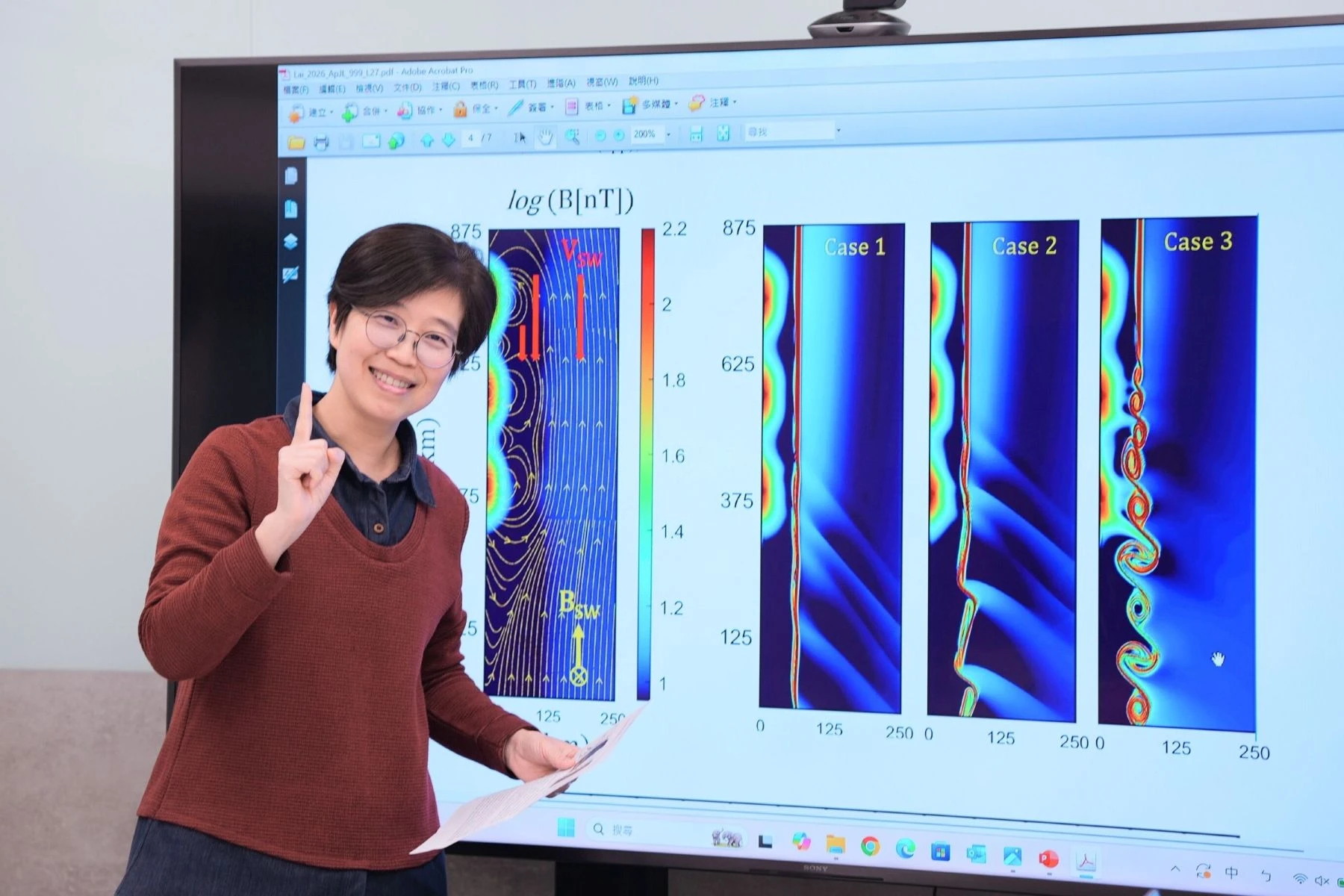
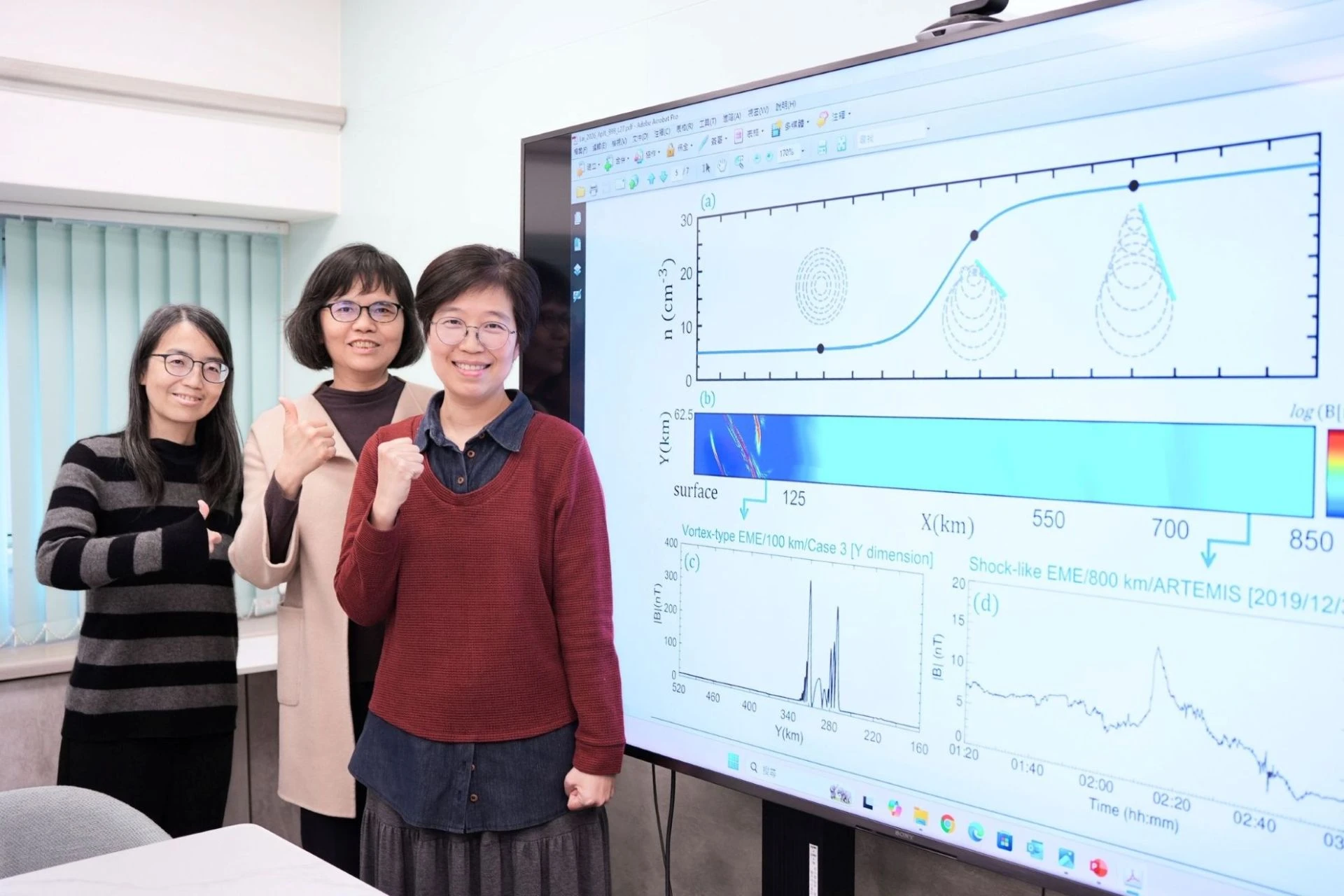
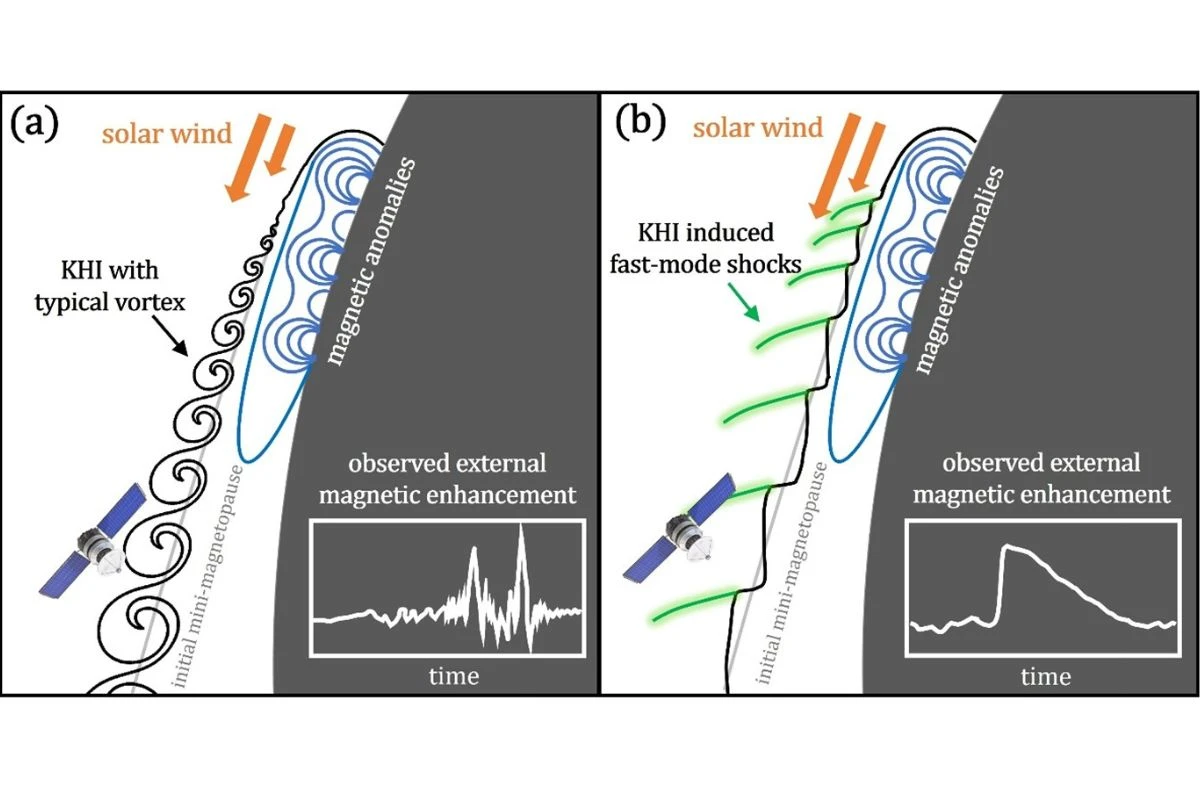
The research challenges the long-standing puzzle of Lunar External Magnetic Enhancements (LEMEs), which have been repeatedly observed since the 1960s yet remain unsatisfactorily explained. By combining numerical simulations with spacecraft observations, the team has, for the first time, proposed a new mechanism for LEMEs and successfully reproduced their spatial structure and amplitude.
The findings reveal that a long-overlooked nonlinear branch of the Kelvin–Helmholtz (K–H) instability can naturally generate shock-like localized magnetic enhancement structures above the lunar crustal magnetic fields, fully accounting for more than half a century of observations. As early as NASA’s Explorer 35 mission in the 1960s and the Apollo missions in the 1970s, scientists discovered pronounced magnetic field enhancements above certain regions of the lunar surface. The magnetic field strength in these areas can spike several times—or even more than an order of magnitude—above the ambient solar wind magnetic field, extending to altitudes of hundreds of kilometers. Subsequent lunar missions, including Lunar Prospector, Kaguya, and ARTEMIS, confirmed that these external magnetic enhancements are associated with the lunar localized crustal magnetic fields. However, existing static magnetic field compression models have struggled to reproduce and explain their steep waveforms, vertical extent, and broad amplitude range.
This newly identified mechanism is not confined to the Moon. It can also be applied to crustal magnetic field regions on Mars and other weakly or locally magnetized bodies. Co-authors Professor Kaiti Wang and Professor Ya-Hui Yang emphasized that the team has made substantial progress across three key areas—lunar magnetic fields, electromagnetic waves, and ionospheric structure—laying a critical foundation for Taiwan’s future lunar scientific exploration.
For more details, please refer to the article published in The Astrophysical Journal Letters: https://doi.org/10.3847/2041-8213/ae4745
相關報導
自由時報:https://news.ltn.com.tw/news/
CNA:https://www.cna.com.tw/
中央大學facebook:https://www.facebook.com/ncu.