

National Central University and University of Surrey Launch 4+1 Dual Degree in Space Engineering
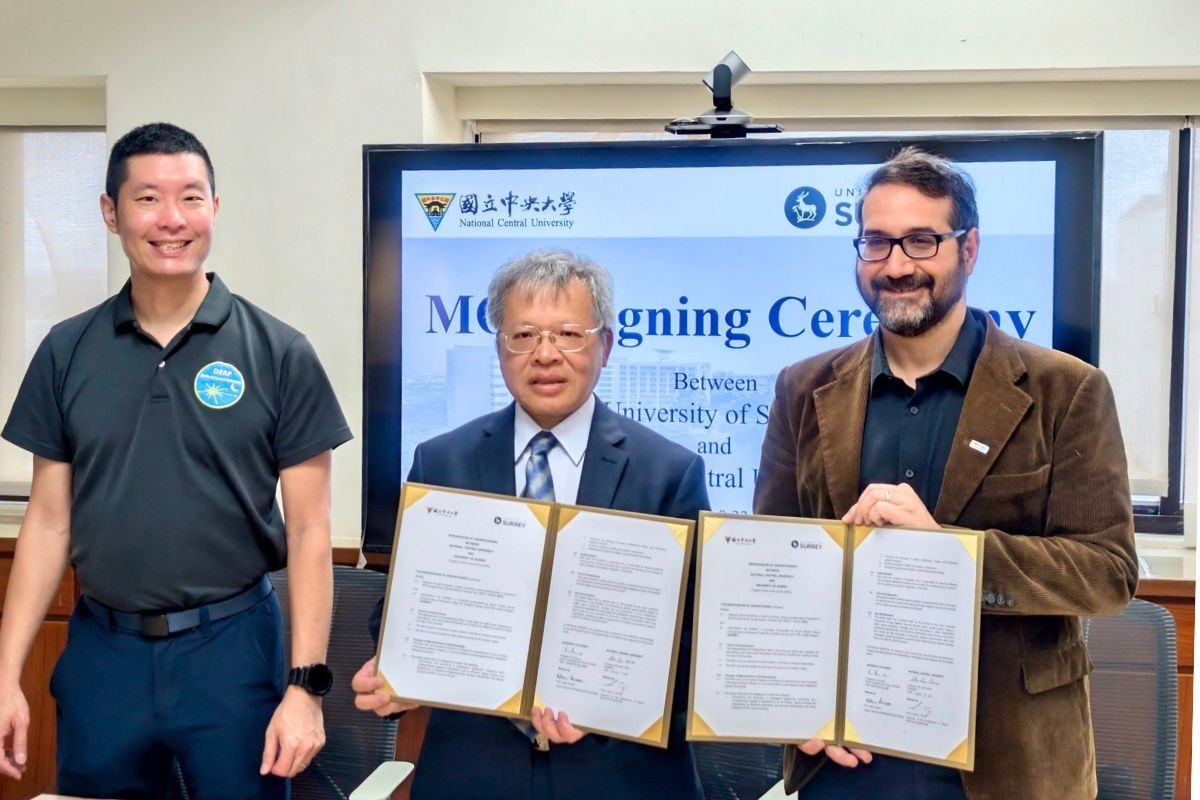
National Central University (NCU) formally launched a 4+1 dual-degree programme in Space Engineering with the University of Surrey this September. At the same time, NCU established a preparatory office for an International Space Cooperation Centre to promote international industry–academia exchange and collaboration with the Surrey Space Institute. With space as a shared priority field, the two universities plan to advance Taiwan–UK space exchange and cooperation through dual degrees, teaching and research collaboration, and industry links.
The University of Surrey is a leading UK public research university, renowned for its aerospace and space-science expertise. It is also the only university in the UK that independently develops and operates satellites. The Surrey Space Centre at the university conducts research in space engineering, including orbital mechanics, lunar-surface engineering, satellite communications, satellite data processing, in-orbit propulsion, satellite remote sensing, the space environment, and space structures and mechanisms. Established at the University of Surrey last year, the Surrey Space Institute is an interdisciplinary research institute integrating engineering, law, biosciences and artificial intelligence to advance small-satellite innovation, space-technology research and development, and international industry–academia talent development.
In the 2027 QS World University Rankings, the University of Surrey is ranked 246th globally. Its Physics & Astronomy subject ranks 202nd worldwide, compared with approximately 351st for NCU. In the 2024 Shanghai Ranking Global Ranking of Academic Subjects, Surrey ranks 36th globally and fourth in the UK for Aerospace Engineering. The university was a global pioneer in the development of small satellites in the 1980s and subsequently spun out Surrey Satellite Technology Limited (SSTL), an internationally recognised satellite-technology company that continues to work closely with the university. SSTL contributed to the satellite bus design and manufacture of the Taiwan Space Agency’s FORMOSAT-7/COSMIC-2 constellation.
The 4+1 Space Engineering dual-degree programme, which began admissions this semester, is open to NCU undergraduates in their third year or above who have fulfilled graduation requirements for a bachelor’s degree in Space Science and Engineering, Physics, or Communication Engineering, and who meet the University of Surrey’s English-language requirements. Through the programme, students may transfer directly to Surrey’s one-year MSc Astronautics programme via a progression agreement with NCU. They will also receive a one-off tuition-fee reduction.
The two universities have also agreed to establish a preparatory office at NCU for an International Space Cooperation Centre, which will promote international industry–academia exchange and collaboration with the Surrey Space Institute. Visiting academic staff from the Institute may teach students at NCU and partner institutions in Taiwan, co-supervise postgraduate students, undertake joint research, and introduce Surrey’s Continuous Professional Development provision for space-industry professionals.
Both sides may also build industry–academia connections and exchanges through Space South Central, the space cluster in which the University of Surrey participates, and through NCU’s industry partnerships and its support over the past four years for the Industrial Technology Research Institute’s TAcc+ international space start-up programme. Together, these efforts will strengthen bilateral space industry–academia collaboration and talent-development capacity.